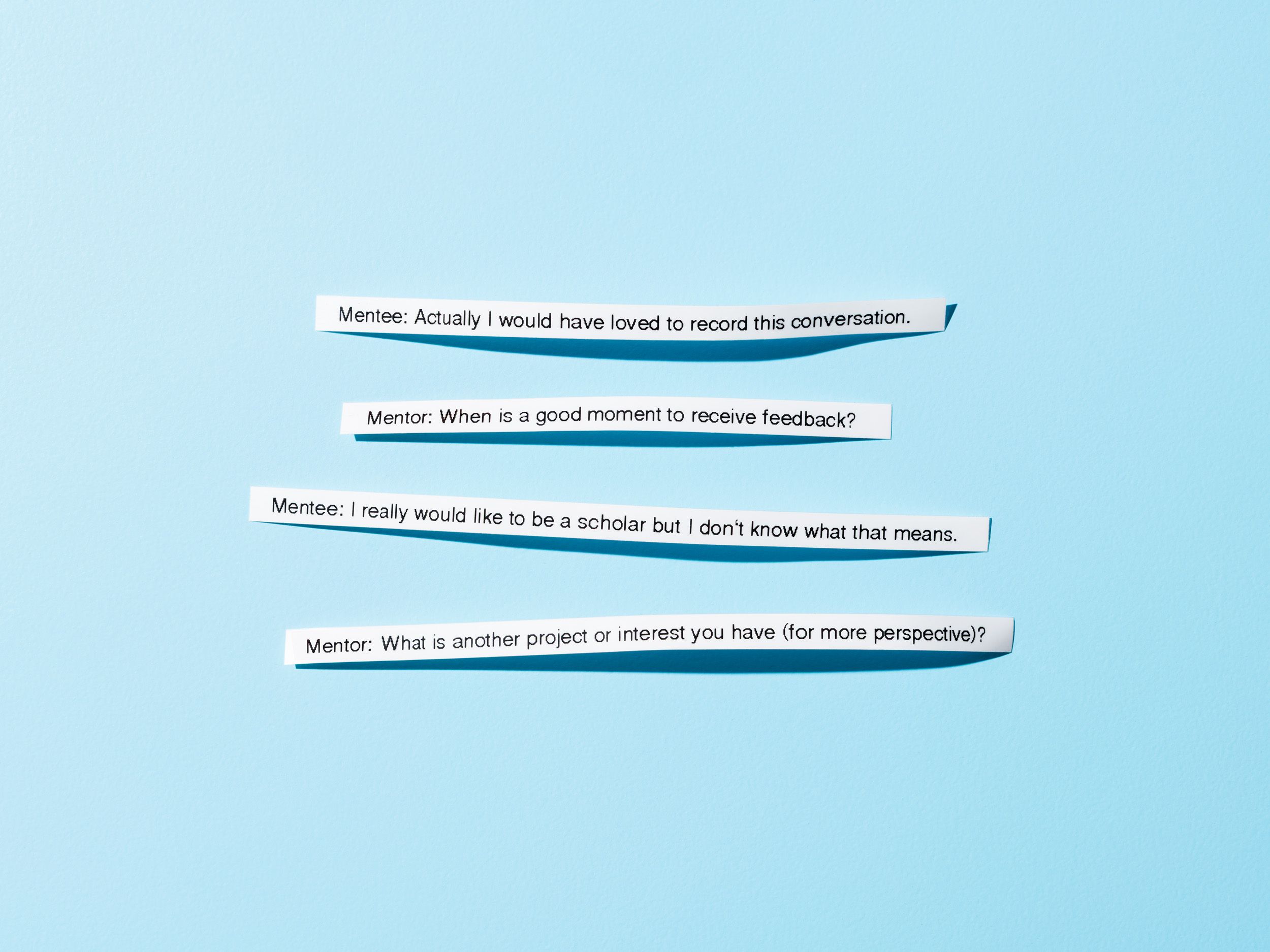
The project Mentoring as Practice introduces a note-spitting machine (a machine, which spits out small pieces of paper with short text inputs) to people currently engaged as mentees or mentors, as well as to those interested in starting a mentoring relationship. Mentoring is a vessel for learning/teaching, often part of everyday study at art universities. Students are accompanied by a mentor in developing their projects, with the mentor responding to the topics or projects the mentee brings to each session. The exact way of working is usually left to the individuals involved, making mentoring a format that raises the question of how and in what constellations we want to learn together.
As a mentee, I was often not fully aware that, with each mentoring session, I was actually involved in shaping how mentoring could unfold. Instead, I found myself questioning certain interactions in terms of how well they aligned with my preconceived notions of what mentoring is meant to be. I realised that unspoken and undiscussed assumptions about the mentee/mentor relationship may limit how we experiment with different ways of learning as mentees/mentors.
This finding motivated the development of a note-spitting machine that circulates questions, statements, gestures, and methods between different mentee-mentor pairings. The machine accompanies mentoring sessions, spitting out notes randomly toward mentee or mentor and prompting both to reflect on, and discuss their preconceptions of mentoring.
The project questions whether a structuralisation of the situation might help to hold the openness of mentoring and invite mentees and mentors to shape/enact mentoring as practice.
The project Mentoring as Practice introduces a note-spitting machine that spits out small pieces of paper with short text inputs to people currently engaged as mentees or mentors, as well as to those interested in starting a mentoring relationship. Mentoring is a vessel for learning/teaching, which is often part of everyday study at art universities. Students are accompanied by a mentor in developing their projects, with the mentor responding to the topics or projects the mentee brings to each session. The exact way of working is usually left to the individuals involved, making mentoring a format that raises the question of how and in what constellations we want to learn together.
As a mentee during my three years in the Transdisciplinary Studies program at Zurich University of the Arts, I often was not fully aware that with each mentoring session, I was simultaneously part of shaping how mentoring could unfold. Instead, I found myself questioning certain interactions in terms of how well they aligned with my preconceived notions of what mentoring is meant to be. For example, after being asked, “How are you?” by mentors, I wondered whether I should return this frequently asked question. Would doing so perhaps undermine an intended direction in the conversation that is meant to be maintained? Which doubts about my artistic practice did I want to bring into mentoring, and which would I rather leave out? What kinds of exchanges would a mentor be willing to engage in? Could it also involve, among other things, discussing the compatibility of artistic practice and earning a sufficient basic income?
In reflecting on the expectations at play in mentoring and on the functions this format can assume, I did not want to solely draw from my own experience. Instead, I wanted to include additional perspectives on, and experiences with, mentoring or mentoring-like relational forms.
To do so, I turned to three further contexts in which mentoring or mentoring-like practices are discussed and enacted. From these, I worked out similarities-in-difference and, by doing so, generated three motifs that guided my reflection on my own mentoring experiences: #Give-and-Take, #Authority/Measuring, and #Transformation.
As a first context, I looked at the mentoring program Berufsziel: Professorin an einer Kunsthochschule. The program was initiated in 2002 by Sigrid Haase (then Commissioner for Women’s and Gender Equality at the Berlin University of the Arts) and still runs today under the nameProf*me. Here mentoring is used as a personnel development tool in the field of gender equality. Prof*me is aimed atFLINTA1* on their path toward a professorship. For one year, the mentees stay in contact with a professor from one of Berlin’s art universities whom they choose as their mentor2. The first five cycles of the program were extensively evaluated, and this evaluation was published3. Across these reports, mentoring is repeatedly described as a #Give-and-Take between mentee and mentor: mentees could expand their networks, while mentors received impulses for their work from so-called junior academics4. This #Give-and-Take is also discussed in terms of institutional benefit. Joint projects between mentees and mentors are thought to ultimately benefit students through improved teaching quality5. Building bridges between artistic work inside and outside the university is presented as something desirable, and mentoring relationships are seen as helping to make this possible6. At the same time, mentoring is presented as a format that offers opportunities for exchanging ideas “abseits von institutionellen Zwängen [outside of institutional constraints, N.S.]”, including reflections on “mit welcher Haltung […] man den Hochschulen begegnen will [the attitude one wants to take in engaging with universities, N.S.7]”.
As a second context, I turned to the project The Hologram, which, based on experiences with the U.S. healthcare system, opposes the economisation of healthcare and proposes alternative care constellations alongside professional healthcare.
The project was initiated in 2016 by artist/activist Cassie Thornton, with considerations on the project published in 2020 in The Hologram: Feminist, Peer-to-Peer Health for a Post-Pandemic Future9. I see parallels to mentoring in the direction of the conversations that take place within these care constellations: a “triangle” of three caregivers tends to the health of a fourth person: the “hologram.” The “Hologram”constellations are presented as a peer-to-peer protocol, with the function of the “triangle” explicitly characterised by a distancing from #Authority and from being experts. The project advocates for a “networked reciprocation” (#Give-and-Take). Each “hologram” simultaneously becomes part of another person’s “triangle”, although that person should not be a member of the “hologram’s” own “triangle10”.
As a third context, I examined reflections from Italian feminism of difference of the 1980s, which addressed a relational form among women* in which one woman* entrusts herself to another woman* who embodies “something more” for her. These affidamento relationships are conceived as relationships initiated through an act of #Authority attribution. Unlike in the project The Hologram, there is no turning away from #Authority here. Instead, in intentionally established relationships of #Authority among women*, the opportunity for women*'s participation in society is seen – one in which they do not orient themselves toward mediating instances of patriarchal structures.
The Italian feminism of difference developed their specific understanding of #Authority starting from the mother-daughter relationship and defining it in contrast to hierarchy and power.
Interestingly, each of the three examined contexts frames mentoring or mentoring-like relationships under an overarching purpose or as the starting point of socially transformative processes (#Transformation). While the project The Hologram is presented as a “social technology for dehabituating humans from capitalism13,” Italian feminism of difference seeks to grant women* a social existence without requiring adaptation to patriarchal structures. The mentoring program Berufsziel: Professorin an einer Kunsthochschule promises improved teaching quality by connecting artistic practices inside and outside the university and at the same time frames mentoring relationships as spaces outside the university for reflecting on university structures.
I began reflecting on my own mentoring experience within an arts university context under the motif of #Transformation and started to see the openly and loosely defined framework of this format as something transformative: it raises the question of how, and in which constellations, we want to learn together. Engaging in this negotiation process through the mentoring format for me means participating in a transformative process of enacting and shaping mentoring as practice.
As a mentee in the study program Transdisciplinary Studies in the Arts, the imperative of shaping learning practices within the mentoring framework became evident in the fact that students could choose their mentors themselves, even beyond the university context, as the study program offers a remuneration to involve people from the outside. This made it possible to integrate people and contexts into the learning environment that were not anchored within the university and might not be institutionally recognised as learning contexts. The transdisciplinary setting also required that expertise and #Authority between teaching mentors and student mentees would not be attributed solely on the basis of the academic hierarchy of student/teacher. Instead, such attributions had to be explored in relation to specific projects and topics, since many of the projects did not take place within a discipline shared by both.
In everyday study contexts, the question “How do we want to learn together?” that mentoring implies may not always be present when entering a mentoring session. The extent to which space opens up for negotiating preconceptions of mentoring, or the needs and wishes that mentees and mentors bring to this encounter might also vary between different study programs (intradisciplinary, transdisciplinary, etc.) and can look different depending on who is involved as mentee or mentor. As Sara Ahmed shows:
I have developed an object that is meant, on the one hand, to serve as a reminder of the space for shaping, and, on the other, to prompt mentee and mentor – should this space not open up – to enter into a negotiation process around their preconceptions of mentoring and needs/wishes for this learning format.
The object initiates an exchange between various mentee-mentor pairings by circulating statements, questions, gestures, and methods that invite response from both sides. Mentees and mentors can themselves enrich this pool of possibilities by feeding the system with questions, statements, gestures, or methods that they have found helpful in mentoring sessions or that they would like to integrate into future ones. The note-spitting object accompanies mentoring sessions and invites mentee and mentor to sharpen and discuss their respective preconceptions of mentoring in relation to – or in contrast with – the slips of paper produced by the mechanism. The object materialises an implicit recourse to prior understandings of mentoring – an appropriation of statements, questions, gestures, and methods associated with it – while at the same time inviting the extension of this shared pool.
Ultimately, the project Mentoring as Practice asks whether a punctual formalisation of mentoring sessions can help hold the openness of this learning format and invite mentees and mentors to shape and enact mentoring as a practice.
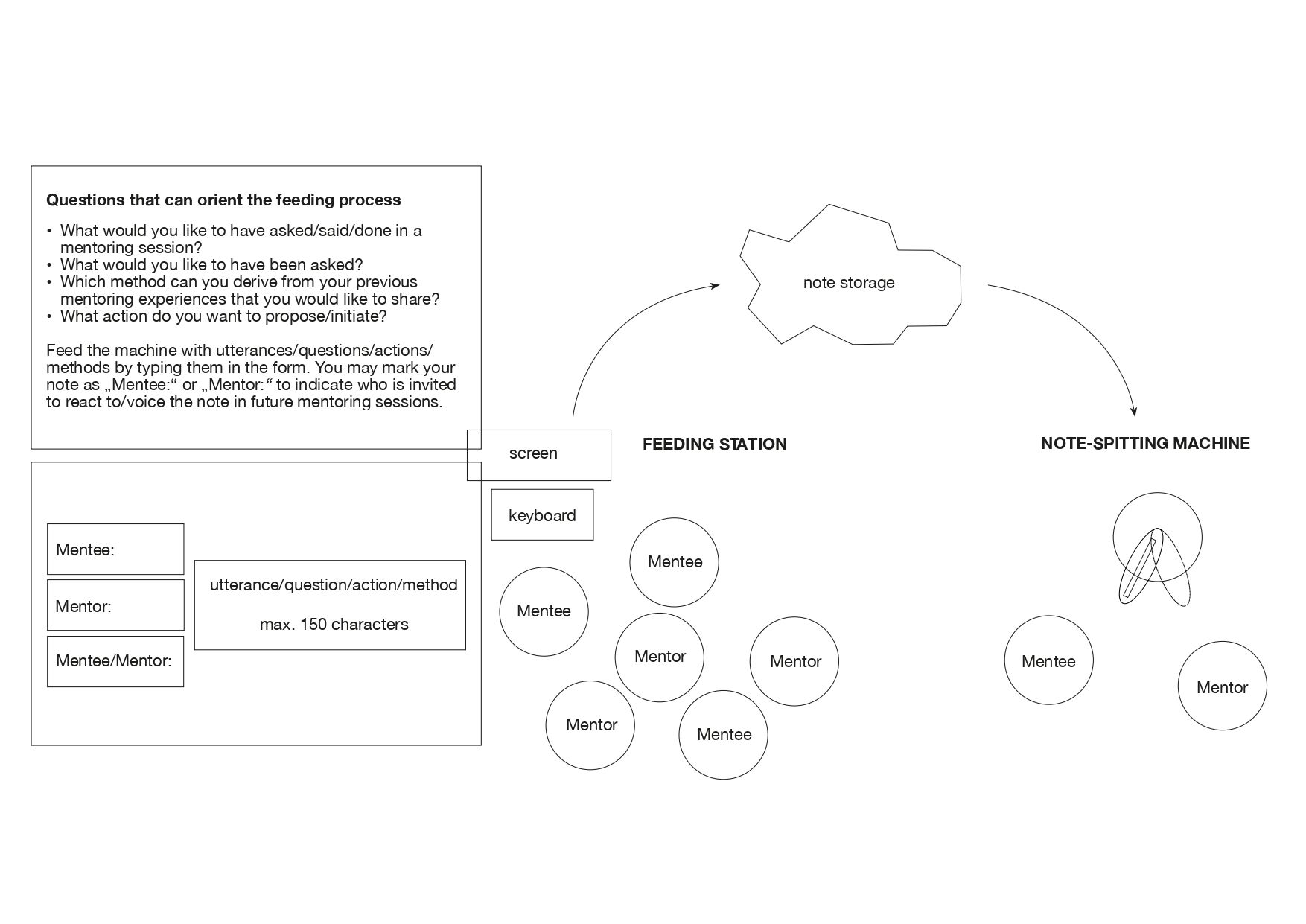
2) sketch of how the feeding station and the note-spitting machine work together
The object – a note-spitting machine – is positioned during mentoring sessions between mentee (A) and mentor (B) and spits out notes at defined time intervals (within a random range) in the direction of A/B. The notes contain utterances/questions/gestures/methods. A or B is invited to read the note aloud to their counterpart in several ways: as an offer for interaction; by distancing themselves from it and thereby updating the mentoring setting as it exists or modifying it in contrast to the slip of paper; and so on. A feeding station is crucial for the setting, where the pool of statements and questions from which the object randomly selects is generated. Mentees and mentors are invited to type on a keyboard utterances/questions they would have liked to say/ask in a mentoring session to note actions waiting to be realised within a mentoring session (“I actually wish I had recorded the conversation.”) or to note actions/gestures that could become a method (“I brought strawberries from my neighbor’s garden, just take some!”). The notes are digitally saved and can be assigned to either A or B, or they are saved under the category “A/B”: here the object randomly decides whether the statement/question will be spat in the direction of A or B during upcoming mentoring sessions. The note-spitting machine draws on the digital storage that is generated by mentees and mentors at the feeding station.
During the SoC Gathering from July 4–6, I collected slips of paper with the peers of the 25/26 cohort for the note-spitting-machine. It was one of the first opportunities to generate notes for the spitting mechanism. In a roughly 50-minute workshop, we simulated mentoring sessions in which the note-spitting object was involved in an adapted form.
I asked the workshop participants to form groups of three. Each group member briefly introduced a topic or project they were currently working on and would like to explore further through discussion. In the next step, each group selected one of these topics or projects. The person who had proposed the chosen topic became the mentee, while the other two negotiated who would take on the role of note-taker during the conversation and who would act as the mentor. For approximately 30 minutes, participants were then invited to discuss the mentee’s topic, or, in the case of the note-taker, to document the conversation. The mentee could express in advance any preferences regarding what the notes should focus on.
To involve the note-spitting-machine in this setting with several mentoring sessions of three-person groups, it was necessary to adapt the way the object functioned, since it existed and currently exists only in a single version and cannot participate in multiple mentoring sessions simultaneously. I therefore positioned myself next to the spit mechanism, and every time the mechanism would have stuck out its tongue and spat out a slip, I projected a note labeled “Mentee:” / “Mentor.” Additionally, a small auditory signal was needed to draw the mentee’s and mentor’s attention to the “spat-out” slip. The mentee and mentor could then decide whether to integrate the statement/question/method/gesture written on the slip into their conversation or to distance themselves from it.
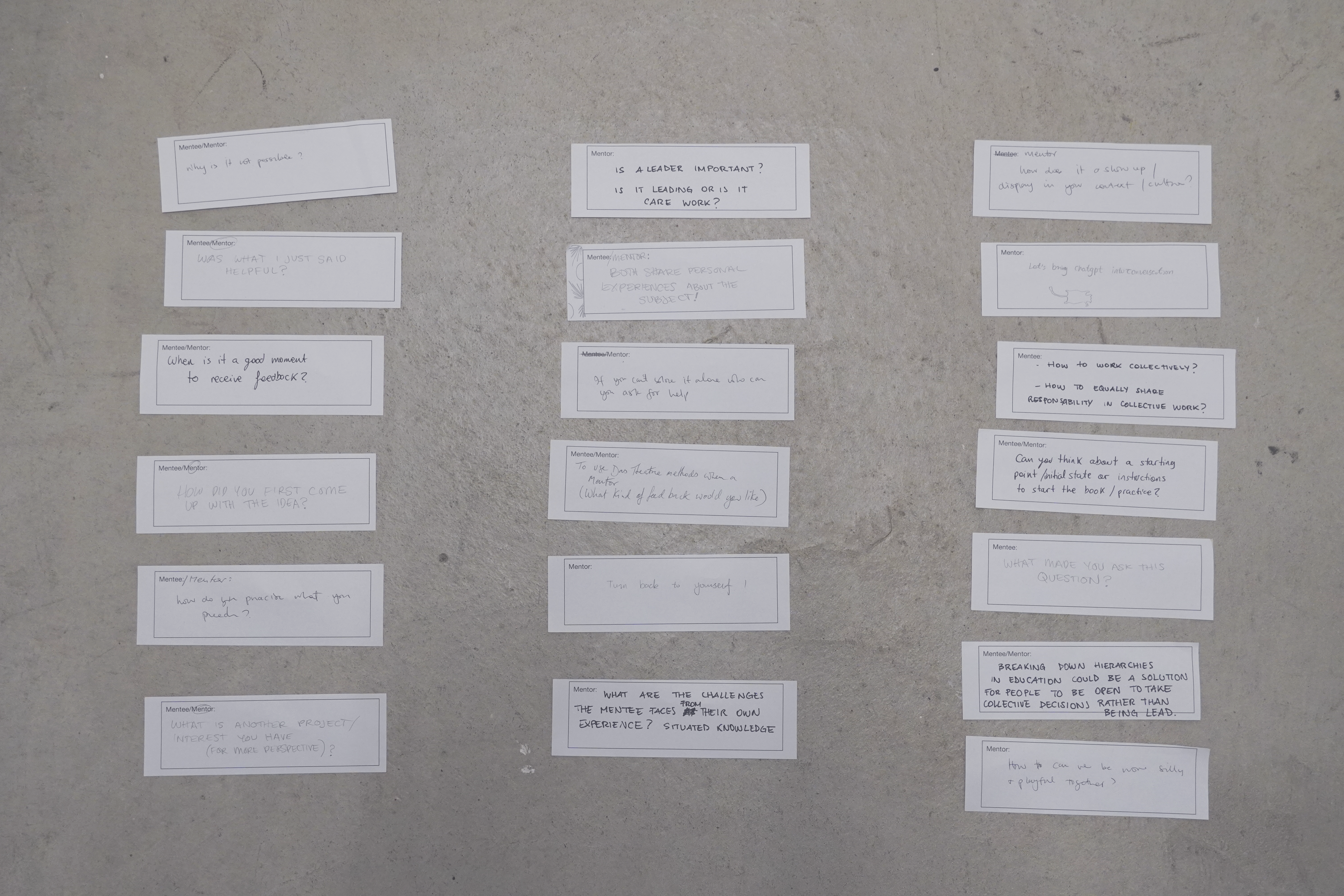
At the end of the workshop, the groups were asked to use the final ten minutes to write down statements, questions, methods, or gestures that could inform future mentoring sessions.
5) notes collected during the SoC Gathering in Zurich, July 4–6, 2025
Mentor: How does it show up/display in your context/culture?
Mentee/Mentor: Why is it not possible?
Mentee: How to work collectively? How to equally share responsibility in collective work?
Mentor: What are the challenges the Mentee faces from their own experience? Situated Knowledge
Mentor: Is a leader important? Is it leading or is it care work?
Mentor: How did you first come up with the idea?
Mentee: What made you ask this question?
Mentor: Was what I just said helpful?
Mentor: Turn back to yourself!
Mentor: Let’s bring ChatGPT into conversation.
Mentee: You could form a silly research/mutual aid group.
Mentee/Mentor: How do you practice what you teach?
Mentor: How can we be more silly + playful together?
Mentee/Mentor: Both share personal experiences about the subject!
Mentee/Mentor: Can you think about a starting point/initial state or instructions to start the book/practice?
Mentee/Mentor: When is it a good moment to receive feedback?
Mentee/Mentor: To use DAS Theatre methods when a Mentor (What kind of feedback would you like).
Mentor: What is another project/interest you have (for more perspective)?
(1)
FLINTA* is a German acronym meaning Frauen (women), Lesben (lesbians), inter Personen (intersex people), nichtbinäre Personen (non-binary people), trans Personen (trans people), and agender Personen (agender people). The asterisk (*) indicates inclusion of additional gender identities.
(2)
Nigbolu, Seda, and Sigrid Haase (2011). ‘‘Frauen auf dem Weg nach oben – Mentoring: Das UdK Berlin-Programm,’’ in Musen Mythen Mentoring, ed. Sigrid Haase. Berlin: Universität der Künste Berlin, 216–217, here 216
(3)
Haase, Sigrid (ed.) (2011). Musen Mythen Mentoring. Berlin: Universität der Künste Berlin, XII.
(4)
Rennert, Martin (2011). ‘‘Grußwort,’’ in Musen Mythen Mentoring, ed. Sigrid Haase. Berlin: Universität der Künste Berlin, 9.
(5)
Haase, Sigrid, and Stefanie Woit (2011). ‘‘‚Nach dem Kongress war mir klar: Ich initiiere ein Mentoring-Programm’ – Ein Gespräch mit Sigrid Haase,’’ in Musen Mythen Mentoring, ed. Sigrid Haase. Berlin: Universität der Künste Berlin, 13–19, here 16.
(6)
Haase, Sigrid, and Stefanie Woit (2011). ‘‘‚Nach dem Kongress war mir klar: Ich initiiere ein Mentoring-Programm’ – Ein Gespräch mit Sigrid Haase,’’ in Musen Mythen Mentoring, ed. Sigrid Haase. Berlin: Universität der Künste Berlin, 13–19, here 15.
(7)
Berger, Renate (2011). ‘‘Wer war Mentor?’’ in Musen Mythen Mentoring, ed. Sigrid Haase. Berlin: Universität der Künste Berlin, 32–34, 33.
(8)
Garrett, Marc, and Cassie Thornton (2020). ‘‘Art, Debt, Health and Care: An Interview,’’ in The Hologram: Feminist, Peer-to-Peer Health for a Post-Pandemic Future, by Cassie Thornton. London: Pluto Press, 82–94, here 89.
(9)
Thornton, Cassie (2020). The Hologram: Feminist, Peer-to-Peer Health for a Post-Pandemic Future. London: Pluto Press.
(10)
Thornton, Cassie (2020). The Hologram: Feminist, Peer-to-Peer Health for a Post-Pandemic Future. London: Pluto Press, 54.
(11)
Libreria delle donne di Milano (1988). Wie weibliche Freiheit entsteht. Eine neue politische Praxis. 1st ed. Berlin: Orlanda Frauenverlag, 173 f.
(12)
The Milan Women’s Bookstore Collective (1990). Sexual Difference. A Theory of Social-Symbolic Practice. Bloomington and Indianapolis: Indiana University Press, 143.
(13)
Thornton, Cassie (2020). The Hologram: Feminist, Peer-to-Peer Health for a Post-Pandemic Future. London: Pluto Press, 13.
(14)
Ahmed, Sara (2012). On Being Included: Racism and Diversity in Institutional Life. Durham/London: Duke University Press, 25, 199, 175.
Cf. also Saner, Philippe, Sophie Vögele, and Pauline Vessely (2016). Schlussbericht. Art.School.Differences. Edited by the Institute for Art Education, Zürcher Hochschule der Künste. Zürich. Accessible at: https://blog.zhdk.ch/artschooldifferences/files/2016/10/ASD_Schlussbericht_final_web_verlinkt.pdf (accessed December 6, 2025). The final report of the A.S.D. research project points out “institutionell verankerte Normativitäten, die über die Auswahlverfahren hinaus wirken und potentiell diskriminierende Effekte bergen: Neben einer Herkunft aus den privilegierten sozialen Klassen und einer adäquaten Vorbildung werden in erster Linie weisse, junge, nichtbehinderte, gesunde und psychisch unbelastete Körper bevorzugt [institutionally anchored norms that extend beyond the selection process and have potentially discriminatory effects: in addition to coming from privileged social classes and having adequate prior education, preference is given primarily to white, young, non-disabled, healthy, and mentally unburdened individuals, N.S.].,” 411.
Nora reacts to specific social situations through object-design processes that invite exploration of social interactions which may initially feel familiar.