A text on practicing family moving between notes on mundane observations, day-to-day family life, art interpretation, cleaning work, contemplation and power analysis. An anti-institutional text against the nation state. A gathering of texts, gossips and blasphemic claims, including 3 side quests to accomplish.
Notes on practicing family
Side quests*:
> find a closed door and knock very loudly
> tell a story …
> find out …
*These are things I did that led me to thinking about the following. I invite everyone to go on similar side quests.
the white man putting the past to rest / German Family / What should not be spoken about
I stand in front of Kunsthaus Zürich, Switzerland’s biggest museum for arts. Beside the main entrance stands a closed door with naked bodies from its bottom to its top. At the bottom of the door there are more female bodies, the higher up the door I look, I see more males. Altogether, I am looking at a bronze sculpture almost 7 meters high with a blackish patina: The Gates of Hell Auguste Rodin, Bronze (Gift of Emil G. Bührle)
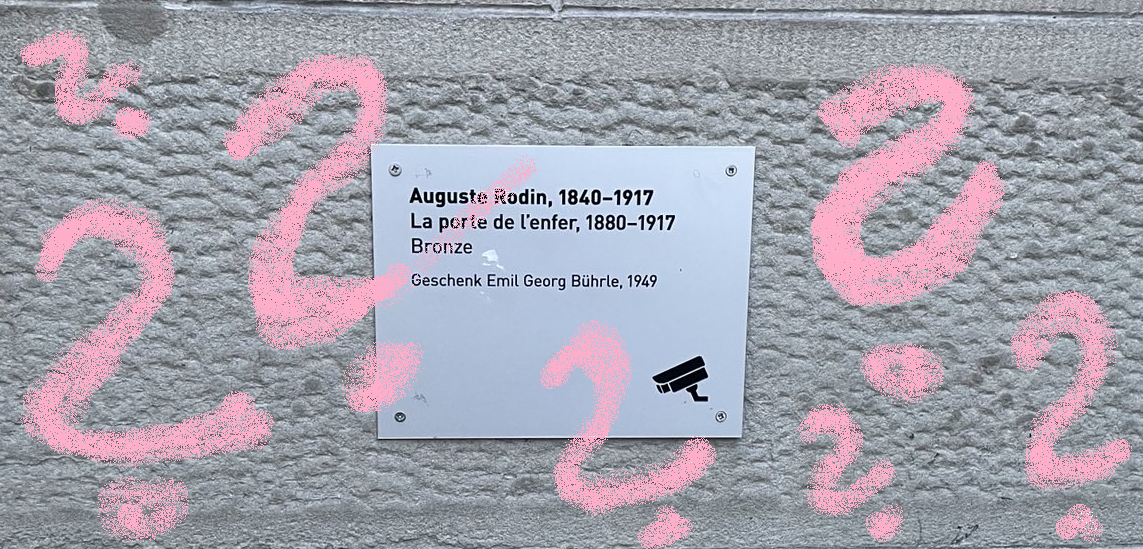
I know that the version of the sculpture standing here right in front of me is the 4th bronze cast1. I know that this cast was once ordered by the German Nazi-Regime, selected to become the entrance of the never realized, so-called “Führermuseum”. Hitler wanted to create for himself in Linz/Austria. They ordered the Gates of Hell at a Parisian foundry and paid for it. It wasn’t finished before Nazi-Germany was defeated in 1945 and came to Zurich later with a sales exhibition, where it was bought by Emil Bührle. The richhhhhh weapons manufacturer who made his money by selling *neutral* weapons to all WW2 parties, including Germany, gifted the sculpture as a present to Kunsthaus. On the information board next to the artwork standing outside in public in the city centre we can read that this was a gift from Bührle in 1949. Why do they not inform readers of the fact that this sculpture is standing here as a result of historical circumstances, including Hitler’s art taste and the involvement of Nazi-money (two times)? I wonder, and I feel angry about it. I thought *great* European democratic institutions like this were supposed to educate in an exhaustive and extensive way. I understood that nobody forgot to mention the missing facts. But there has been a decision made to only tell the convenient part of the sculpture’s history, that is also the museum’s history, that is also the city’s history, that is also the country’s history, that is also the neighbouring country’s history, that is also European history.
______________________________________________________________________
I think of my father and how he wouldn’t want to talk about the past when I was asking him about it. How he would tell me: “That’s just how it was” without further explanation. I wonder if there could be a connection between him and the museum doing the gesture of *putting the past to rest*, because it is over now, you know?
---*Putting the past to rest*2 as a hand pushing aside something that has been, and wants to make space for something that is now. The intention behind this gesture might be to create a space where there are no worries and loads from before, a space that is not charged with foregone burdens and hardships. Relatable—when one goes through something that costs them a lot, they might prefer to let it be, and don’t wish for their descendants to face a continuation or repetition of their suffering. Then there is also the promise of capitalism that progress = more comfort, improved comfort, better comfort
*Putting the past to rest* is closing a door and turning towards a new space, free from inherited burdens and old debts, like finishing something or containing it---
My father very rarely shared anything from his past. I would ask him how things were back then, how he made decisions, why he left home, and he responded with an “Ah” that was more like an aching exhalation than an answer. His two brothers are pretty similar, they don’t see any necessity to answer a question that might bring them back to a place they left long time ago in their childhood.
---*Putting the past to rest* is a patriarchal and colonial move---
______________________________________________________________________
We know3 how European colonizers, among them Germans, went out into the world to *explore* and to *discover* some *unknown, mysterious, wild, simple, foreign, uncivilized* cultures, peoples, and lands. When they arrived on indigenous land without being invited, they did not behave like respectful and polite guests waiting to be hosted. They just sat down at the table, took over, declared the table, the people, and the land their property, and installed a new order as if nothing was there before. Centuries of existing cultures and traditions were treated as irrelevant to the project of European civilization, time, and history were put on reset by the new foreign rulers of the violently conquered territories and people. As if time in the colonies, the so-called “New World”, started only after the arrival of the colonizers. As if there was nothing before. In this way, European history was exported around the world to become global universal history. In this way, it was also possible to claim everything they found as theirs: land, natural resources and commodities, cultures, riches, knowledge, animals, plants, and humans. Another line of the development of modern Europe, that is wealthy, democratic, civilised, peaceful, stable, is the rise of patriarchy in the context of the formation of capitalism. Women were excluded from common and public spaces and confined to the private and domestic sphere. Female sociality, friendship, knowledge and wisdom were delegitimized. Work and practices associated with women were devaluated. “Immoral” women and others who did not conform to social and gendered norms were persecuted as witches. That way it was possible to concentrate all power in the hands of men, the subjects of the Enlightenment and the new modern society. Women and children, the family, became part of a man’s property, just like land, house, stock, and other forms of capital. While before tasks like doing the laundry, cooking, taking care of children and elders, medical care of the sick, midwifery, and birth assistance have often been shared amongst communities as collective practices, these collective spheres were destroyed and with them centuries of communal knowledge and practice systems in which women were carriers of wisdom and know-how. In favour of the new established science systems of *Modernity* old traditions had to disappear. The past was pushed aside for the creation of a new time of free and independent (male white) individuals.
______________________________________________________________________
My father was born 1946 in a Bavarian village of around 30 inhabitants. I speculate at this time no one talked about the past. After WW2 the whole Germany must have continued their denial of the genocides committed by the Nazi-regime with the German society being complicit. Silence must have been the order of the day back then, about what has been seen, witnessed, heard, done, known, during the past 12 years (and before). At least this was what I had repeatedly heard: Nobody talked about the discrimination, prosecution, detention and mass killing of Jews, Sinti*ze and Rom*nja, persons with disabilities, so called “asocial” persons, political and war prisoners, gays and queers.
It was the time the Nuremberg Trials of the Major War Criminals were taking place, where 24 Nazis were brought to justice, who invoked their own ignorance and lack of knowledge, denied or downplayed their responsibility, and justified their innocence. “Didn’t know.” “Only followed commands.” “Cannot remember.” How did *ordinary people* in Germany perceive this? Did they recognize themselves in the defendants? Did these men help them to outsource their own responsibility? ---*Putting the past to rest* - one could think this is part of democratic history of Western nation states who established values like freedom and liberty, equality and justice through violent exclusions and extractions, only for some. And while their heroic stories of conquests do not work anymore since they made themselves the great peace makers, they found other ways to keep on justifying their hegemonic position in the capitalist competition of nation states4---
______________________________________________________________________
In the 2 post-WW2-Germanys the political intentions to denazify German society were put into practice only up to a certain point. GDR5 declared itself an “antifascist” state and prosecuted former Nazis in a stricter way than West-Germany. Still, the perpetrators found their ways back into power positions. FRG6 made a comeback easier for old Nazis, by accepting their excuses and lies in court and making use of their *expertise and experience* for reconstructing the nation state and integrating into the *West*. Former Nazis were often in high positions in the FRG. While not talking about collective responsibility for the genocides and atrocities that have been going on, two *new* nation states have been built back up with Nazis in various positions of power, and the workforce and labor of many migrant workers whose children until today must prove they are *German* enough7. Throughout reunification in 1990, where the vibe of another new national era was reignited and the former GDR state system was taken over by West-Germany, the idea of the great German nation is being carried on to the point that the Federal Republic performs a culture of remembrance in which the uniqueness of the Holocaust is central to the self-conception as a moral, purified, *normal* society of democratic individuals, freed from the Nazis. This results in guilt-pride8 as a sense of moral superiority as a nation and at the same time, an individualized responsibility everyone carries for themselves instead of understanding what collective accountability means. History is being told in a way that doesn’t really tackle the image of oneself, but comforts, and helps to justify capitalist war politics called “historical responsibility” and “Staatsräson”.
______________________________________________________________________
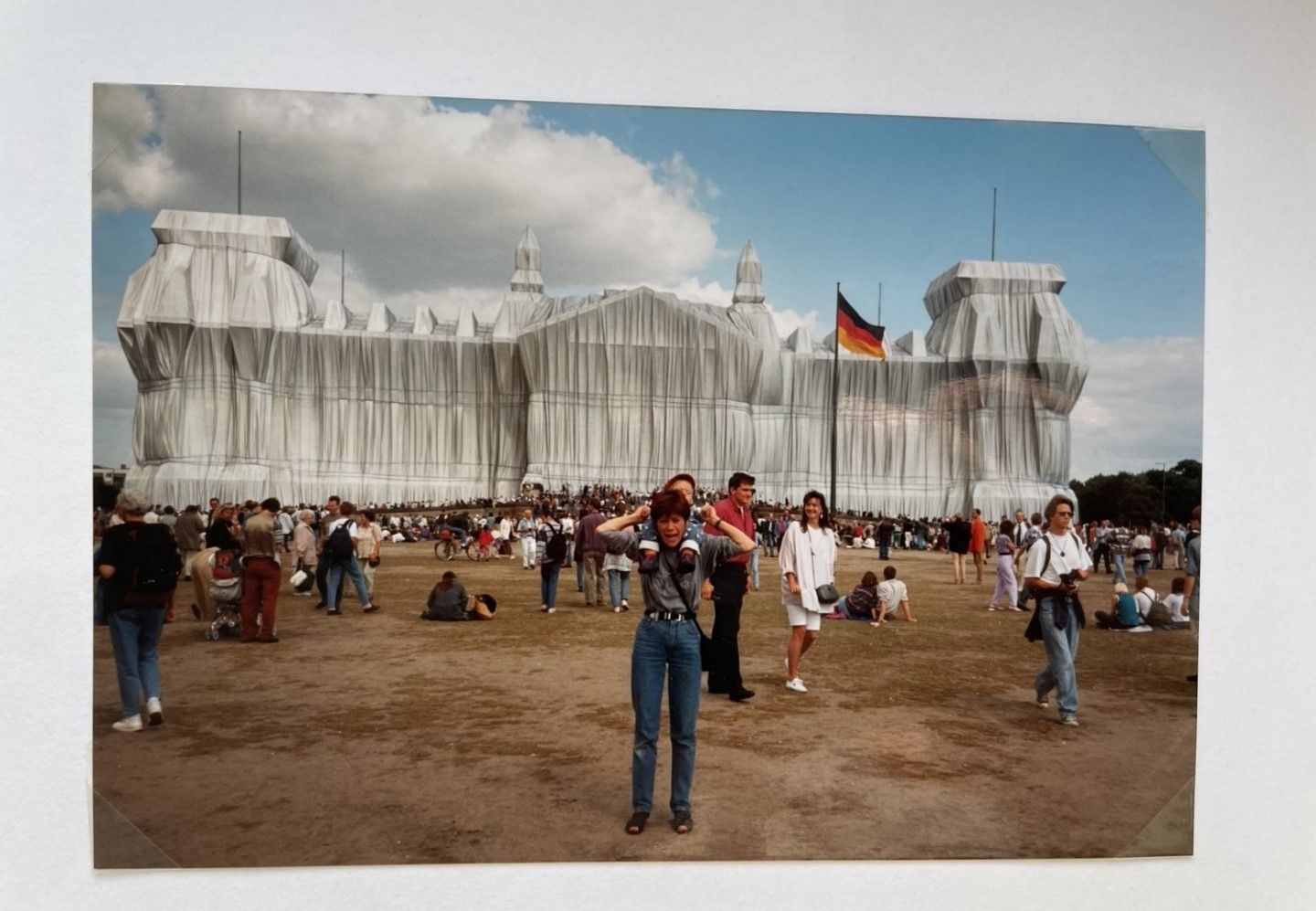
---I don’t believe it is liberating to forget about how we came here. Because it doesn’t really disappear. It’s just veiled like the German Bundestag in Berlin 1995, wrapped in fabric like a gift--- What has been hard for my father affects me even though he tried to keep it away from me.
______________________________________________________________________
Coloniality continues today and reaches into Western democracies, where labor and social division are organized along race, class, and gender lines. While Germany deals with its colonial past in a sketchy way, many migrant workers are doing the hardest and worst-paid jobs for this society without appropriate recognition and access to the *good life*. Their work contributes to the German economy in ways similar to the forced labor of Nazi extermination and exploitation, the war as well as extraction during German colonialism. In the context of European Enlightenment, liberation processes from a religiously justified feudalism system shaped the idea of *freedom* as freedom from dependencies and domination, to being an autonomous individual. In our high-tech neoliberal capitalist system, once a certain standard of living has been achieved, individual freedom aims to free oneself from reproductive work such as cleaning, washing, cooking, and other forms of caregiving. Freedom for Germans often includes a liberation from historic guilt. They don’t want to have to take care of their past. They want to say, “Never again” and continue their future-oriented way of living, *finally in peace*. They want to live happily in denial, saying “We are not racist”, while fascism is coming back to town and German families slowly forget about their Nazi heritage.
washing the guilt away / white cube / what one could think of when standing at the Gates of Hell
I can walk through Zurich and pass by the central train station. Switzerland is very proud of their punctual and well-ordered train system. Trains are expensive and clean, the extended office area of the well-paid employees commuting between the cities. The trains stand empty in Zurich station and people dressed in orange pass through them, collecting the waste, emptying the trash cans. They look tired and as if in a parallel world to all those in transit. I can walk through the city of Zurich and pass by the biggest art museum. They are very proud of their collection, giving a taste by positioning a huge bronze sculpture beside the main entrance for everyone to see. A person on a lifting platform stands close to the sculpture, wiping it clean with a cloth. I learn that after leaving the sculpture outside for many years where it was oxidizing and turning green, they changed their maintenance concept, reversed the oxidation process and applied layers of wax on the material which preserves the patina the way the artist had intended it 100 years ago—keeping the Gates as if no time had passed since then.
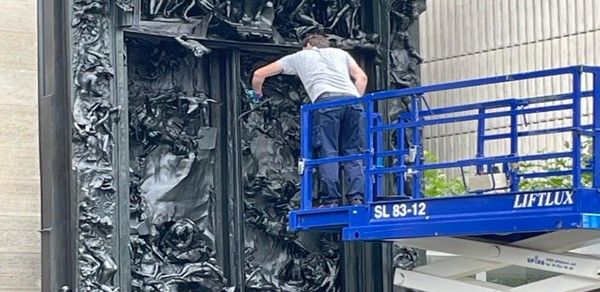
The Western museum institution is working to collect, preserve, conserve, educate, and make accessible. In white spaces it presents objects and art works often out of their contexts of origin, creation, and history. It displays and proves, produces and reproduces legitimized knowledge and truths. Its basic architecture, the white cube, illustrates neutrality and objectivity, and appears harm- and guiltless. The clean surface of the space neutralizes the rot of historical and present circumstances of violent extractions. What we should see is the present, now-now-now, timelessness. Kunsthaus Zürich placed the Gates of Hell in front of their door to build a bridge to the dwellers of Zurich9, to represent their collection, to represent European arts traditions, to represent Western Modernity. Only 2 years ago they decided to take care of the sculpture in a way that includes its contextualization: inside the enormous new building, funded by Bührle's weapons-money10, they put a small sign sharing about the Nazi-connections of their version. In this new building the cleaning staff are not hired by the museum but outsourced to an external service provider. Even though they do the same task, the conservator is being paid way more salary than the cleaners. Here we move between engineered visibility and invisibility: what becomes apparent is the care work the museum does to maintain the status quo of art works, objects, and royal entrances to exhibit a specific narration of their subject. This generates its reason to exist. What disappears in the white space is the daily cleaning work, happening in isolation before or after the public opening hours of the institution, keeping the sacred halls pleasant. It is the things and people that are excluded and not part of the exhibition world because they never visited a museum and aren’t addressed as visitors or are not considered *art* or *history*. It is talking about how the objects ended up in the museum, where the money comes from and where it goes to. It is the ongoing extractive functioning of the institution. It is the reproduction of systemic violence, disappearing behind symbolic and performative reparations that do not mean actual change. We see the whitewashed facades and walls of an architecture that is always clean, while the labor behind this neatness is kept invisible. Like the museum11, the family is not only a place of knowledge production and transfer but also an institution of care. As the so called *nucleus* of (Western) society it is the place where human life is being reproduced— literally and also through daily practices of nurturing, feeding, washing. The capitalist privatization (and isolation) of care work finds its strength anchoring in the nuclear family, that holds heteronormativity and patriarchy in place and passes on social norms. Family is often the place where we learn about ourselves and the world, where we come from, and how we can sustain a living in the future. While it works in service of continuation and persistence of a lineage, possessions, knowledge, and traditions, a family’s narration of the past is often fragmented. The loss of parts of history can have many different reasons, like collective or individual conditions of extinction, expulsion, and displacement, colonization, migration, war, environmental catastrophe, persecution by authorities, hegemonic oppression, theft, oblivion, illness, and so on. It can happen through selective remembrance aiming to cut off inconvenient legacies, through silence trying to avoid discomfort, denying guilt, and detaching from responsibility.
______________________________________________________________________
I remember some defensive vibe my parents had when answering my questions about my grandparent’s lives in Nazi-Germany. I feel they had copied the stories from their parents saying one couldn’t do anything other than being obedient to the fascist regime. Following this argument, for German families, too, the conformity to the state order became a question of survival. They could talk about the hardships of war, about captivity, about how their Jewish friends disappeared and how they couldn't do anything about it and thus tell their own stories of suffering. ---The move of *putting the past to rest* can be seen as a manner to keep up and reproduce the status quo of power relations, capitalism, and nation states. The way Germany tells its own history, it remakes itself in a way that secures its stance throughout the course of time.
One hand pushing aside the past, the other one holding space following specific ideas of who belongs to the nation, who qualifies as a citizen, who deserves protection and care, who does the washing, who carries responsibility, who is part of the family, and who is outside of it, as a threat for the nation’s safety, security and stability---
______________________________________________________________________
When I look at the falling bodies, in hell for their sins in life, I must think of drowning people, of the fortress Europe and folks dying at its closed doors. Of the Mediterranean Sea and the Atlantic Ocean being mass graves for displaced people. I see the figure of the “Thinker” sitting above the suffering, observing, thinking with every muscle and can’t help but wonder if Rodin or Hitler or Bührle saw themselves in this figure. Of all the institutions that promise to take care, the state is the most all-encompassing one12. It feeds the delusion of care through divide and rule, being “un-caring” to the ones it positions outside its borders. It vows to be the great caretaker of citizens, their well-being and safety, of national good and international order. To fulfil this pledge, it rather highlights accomplishments and hides malfunctions, adapting official narratives towards the effect of necessity and the absence of alternatives. Like the nation state, the family seems to be *natural*—as if there were no other ways to organize social life amongst humans. “Like a microcosm of the nation-state, the family incubates chauvinism and competition. Like a factory with a billion branches, it manufactures ’individuals’ with a cultural, ethnic, and binary gender identity; a class; and a racial consciousness.”13 The impression of naturalness normalizes violent exclusions that make the formation of an exclusive unit possible. It stabilizes the enforced order, and maintains the limited space for some individuals to take their seats at the representative table while others serve in invisibility. To push past the costs of the comfortable good life, filled with nice art pieces and good memories, moving them out of sight, is a move realized within and by the father and the family, the museum and the state. They share the same patriarchal authority that normalizes violence in the name of progress, wealth, stability and freedom. What the Gates and family have in common, is the fixation of a specific idea of life, of *the good*, *the beautiful*, the *natural*, and *normal*. The sinful go to hell, the ones free of sin can sit at the family table in their safe space and observe the suffering.
Mum does the washing / Gossip / Seeing the cost
Rodin’s “Gates” show the artist’s interpretation of the human condition as suffering and precariousness. Some people see the similarities between his modelled figures of naked bodies and images documenting hysterical attacks, taken in Paris, where he lived and worked, being big friends with the leading medic in hysteria research and treatment. The artist is highly praised for his magical hands moulding the figures. Some people say his student and partner, Camille Claudel, not only modelled for him but also fashioned the hands of his sculptures. She always stood in his shadow, spent 30 years in psychiatric institutions, and was only recognized for her artistic work after her death.
______________________________________________________________________
did u ever wonder
how this world finds back into place after
a full day of a million things being done by all of us?
it seems to happen as if by an invisible hand
magic
do u remember waking up as a child in the morning
to a full new day ahead of u, with a chance that all the ghosts from yesterday could be gone?
washed away by the rain
reset, delete, maintain, cultivate, empty, refill, foster, carry away, bring anew, reproduce, put back, clear up, hold together, preserve, clean, polish, wipe, care, love, work
the present keeps track of the past in strange ways
good morning, did u have a dream ______________________________________________________________________
Reproductive labor is privatized and individualized, everyone alone takes care of their own shit. It happens behind the scenes, so that one could believe the dirt continuously produced by all of us disappears by itself. Care work is structurally pushed to the margins of *modern life* in *civilized* societies, not only marginalizing the activity itself but the people who do it, often reduced to their work, only valued as human resource, as work time, as executing body. Invisible, it becomes a standard, granted, natural, and normalized. It becomes part of the architecture we move thru that things are clean, at their determined place, in order, in control. How this cleaned up state of the world comes into being is out of focus, time is happening now, oriented towards the future, it is not relevant what was before. There is a detachment from the necessity of care taking—as “Mum Does The Washing” or somebody else that we don’t even know. There is a denial that it is essential for surviving. A lifestyle of detachment and denial is possible through privilege enabling for some to not do any reproductive labor at all and to live life as if it wouldn’t cost a thing. It’s the lifestyle of Western society, of the rich, of White supremacy, of the individualized way of life where we strive to reach a life standard without having to clean up.
______________________________________________________________________
When I started saying “Thanks for cooking” at the family dinner table, my mother, my father and other older cooks often reacted not at all or with a version of “sure!” that sounded like a blame. As if me thanking would include questioning the assumed naturalness of this circumstance. Instead of appreciation it sounded like criticism to them.
Care is feeling a sense of responsibility, looking after oneself and each other. Being aware of the work that is sustaining our world and our life being done right now, yesterday, and tomorrow. Being aware of the patriarchal, colonial, and nationalist-fascist violence that still shapes this place and this time.
Taking turns to do the work, share, acknowledge, clean up collectively without concealing guilt and accountability, practice family beyond blood lines, ideas of owning, similarity, genealogy, nationality, and uniqueness.
The past ain’t over, but reaches into the present and the future, no matter if we try to ignore it or not. As we are keeping the gates that are supposed to separate artificial units of time from each other, we can decide to open the doors, destroy the division of time-space and maintain a space that instead connects.
Facing Germany’s genocidal history means discomfort not purification. Cleaning that doesn’t wash the guilt away but makes it approachable for scrutinization and the allocation and the understanding of accountability.
______________________________________________________________________
At the bottom of the Gates of Hell, we can find the “Kingdom of Mothers14”. This is the place where life seems to come from at the beginning of the journey to hell. This could be the place to occupy together, mothering each other, practicing family as integrative care, taking care of one another, as a counter practice against the nation state. Abolish the institution that pretends to save us and engage in the doing, the work. Gossiping about Germany. Cheating on the fatherland.
tbc
tbc
tbc
tbc
(1)
Most probably, there are ambiguities on which of the first 4 of 8 bronze versions in total stand where.
(2)
This is translated from a German expression “die Vergangenheit ruhen lassen” which basically describes a gesture that points the attention to the now or the future instead to keep oneself busy with what happened before.
(3)
Among many more some authors we learned that from: Frantz Fanon, Sylvia Wynter, Gayatri Chakravorty Spivak, Edward Said, Walter D. Mignolo and many many more.
(4)
In this text I am focusing on Germany as a Western democracy, without discussing other political systems or making comparisons with them.
(5)
German Democratic Republik (DDR) was administered by and became part of Soviet Union.
(6)
Federal Republic of Germany (BRD) was administered by the Western allies (USA, France, GB) and became part of NATO.
(7)
Which shows not only the continuation of racism as systemic structure and incorporated in bodies and minds, but also a narrative in which the fact that Germany is an immigration society is not being told.
(8)
Eg. explained further in this video: Guilt Pride: A German Vanity Project Conquering the World | just for notes (thx to my teacher at uni showing me this)
(9)
Information shared by employees during an interview
(10)
See text part before
(11)
I refer to the nuclear, heteronormative family that is most widespread and normalized in ”Western” societies as basic social structures and units.
(12)
Bonaventure Soh Bejeng Ndikung (2021): The Delusions of Care, p. 35
(13)
Sophie Lewis (2022): Abolish the Family. A Manifesto for Care and Liberation., p. 6
(14)
I found this name in an art-historical publication about the Gates in German and translated it here myself.
caro bodensteiner
Research-based theatre and multi-media arts.